How to Build a Winning Creator Boosting Strategy

.jpg)
Boosting has quickly become table stakes for brands running creator campaigns. The number of creator posts showing signals of boosting climbed 166% year over year in 2025. But here’s the catch. During that same period, engagement per view dropped about 7% across industries in the US market, with similar movement in Europe.
What does this mean? More spend is not automatically producing better results. A lot of brands are boosting harder without boosting smarter, pushing content to audiences who simply are not interested.
The good news is that this is a solvable problem. It comes down to knowing what to boost, which creators to put budget behind, and which platforms fit your goal. That was the focus of our recent webinar, where Holly Jackson, VP of Influencer Marketing Insights and Innovation at Traackr, sat down with Haley Schluter, CEO and Founder of Heart and Logic Media, who has built data-backed boosting strategies for brands including L'Oréal, LVMH, and Function of Beauty.
Why should brands boost in the first place?
Before getting into tactics, it helps to level set on why paid amplification earns a place in the plan. There are three main reasons.
- Organic reach is not always enough on its own. Feeds are packed with creator content, brand content, and boosted content, so getting into an audience feed is harder than ever. Paid amplification lets high-performing content scale beyond a creator's immediate followers.
- Boosting turns good content into predictable performance. Media spend gives you control over targeting, frequency, and outcomes, along with more guaranteed visibility.
- It extends the lifespan and ROI of your best content. Paid support keeps top-performing posts in circulation longer and reaches new audiences over time, which increases the return on your original creator investment.
But knowing why to boost in the easy part. The hard part is knowing how to boost well.
Six tips for building a smarter creator boosting strategy
Tip #1: Start with a baseline, then let the data pick your candidates
The first step in any creator boosting strategy is understanding what is happening in your category. You want to know how much of the attention on branded creator posts is actually coming from content that has been boosted.
This is where Traackr comes in. You can see your total performance broken down by organic creator conversations, paid activations, and boosted content side by side, for both your brand and your competitors. That view answers questions that are otherwise hard to answer on your own: What share of your attention is paid versus organic versus boosted? How do you compare to competitors? What are your top competitors quietly boosting with paid media, and why?
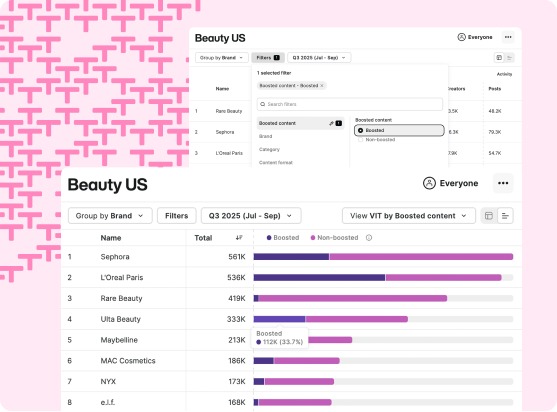
From there, zoom in on the content earning attention. Look for high engagement, with particular attention to strong save and share rates. The patterns will tell you which platforms are getting prioritized, which formats perform best, and which creator tiers are most efficient. Then switch to your own organic content to surface your best candidates to boost next.
"If you've never boosted before, ask what is something you've created that has worked before. Was it a video? Was it a static? Was it silly, or very straightforward? Learn from that, then throw it out there." —Haley Schluter, CEO and Founder, Heart and Logic Media
Tip #2: Design content to be boosted from the very start
At Heart and Logic Media, Haley builds creator content that is designed from day one to be boosted as advertising. The heart of her approach is a duality. Creator content works because it is authentic, and that authenticity has to survive the shift into paid. At the same time, certain advertising fundamentals have to be layered in from the beginning.
So, she set these as clear non-negotiables, which impressively pulls an average ROAS of $9.44:
- Communicate the brand name or the content hook within the first three seconds.
- Keep videos inside the category ad sweet spot. For many creators that lands between 25 and 45 seconds.
- Use simple text overlay on the intro and outro frames, with supporting overlay throughout, treated as dynamic design with real hierarchy.
- Layer in low-volume, royalty-free music for added dynamism.
- Keep the pace quick but not rapid, and cut frame redundancies.
The goal is to combine your influencer's channel best practices with your category's ad best practices. Setting that expectation early lifts the creator's work too.
"Sometimes as we coach creators through the content, they'll say, wow, thank you, I didn't know that. I'm going to start doing text overlay on the first three seconds of all my videos." —Haley Schluter, CEO and Founder, Heart and Logic Media
Tip #3: Match your platform strategy to where you sell
According to Haley, every platform works differently under the hood. TikTok pairs reach and frequency buys with TikTok Shop, so someone can discover your creator content and check out without ever leaving the app. Meta works differently. Its strength is precise prospecting and retargeting, showing your content to the right people and sending them to buy wherever you sell.
That means your platform choice should follow where you actually sell. If your product is shoppable on TikTok, its all-in-one setup is hard to beat. If you sell on your own site or at retail, Meta's retargeting maps cleanly to ROAS.
And if you’re just starting to get serious about boosting, Haley suggests starting on TikTok, where the collapsed funnel lets you test and learn against a lower budget.
"Short form can be kind of agnostic across all your platforms. The nuanced infrastructure deviations you make based on where you retail and where you're serving the media are really paramount to the success of the buy." —Haley Schluter, CEO and Founder, Heart and Logic Media
Tip #4: Measure what matters, not just reach
Before you measure anything, start with your objective. Whether you are building awareness, moving into consideration, or driving purchase, that goal decides which numbers actually matter.
Beyond reach and impressions, Haley shared the signals her team leans on: clicks and click-through rate, CPM as a measure of the cost of reaching your target audience, hook rate scores and relevance indicators, and query lift on Google and social platforms. And when asked which single metric she checks first, click-through rate was the immediate answer.
Top tip: To understand how a post is performing, give it no more than 48 hours before judging early signals in likes, comments, shares, saves, site traffic, and query lift.
Tip #5: Break down the silos between teams
One of the biggest challenges brands face is that the people who own creator relationships often do not control what gets boosted. That decision usually sits with a media team, a paid team, or an agency. Haley has navigated this throughout her career, and her advice is to speak your counterparts' language and show the value creator content brings to their goals.
Part of that shift is recognizing that influencer content is no longer just an earned channel. New platform capabilities have given it real value inside paid media, which changes how other teams see your work. The clearest example is first-party audience targeting. On Meta, you can now target an influencer's first-party audience in your media, which is genuinely valuable to a media or commerce lead.
"You might say that to your media counterpart, and they may say, wow, you just unlocked a first-party audience for us." —Haley Schluter, CEO and Founder, Heart and Logic Media
Boosting creator content also lets teams pressure test messaging. A creator who goes viral emphasizing a benefit you had overlooked hands the messaging team a real signal. Add the volume of content you can route to retail partners like Sephora or Ulta, and the case for collaboration makes itself.
The takeaway is to know how to position your role and the value you bring, then deliver tailored reports to each team until they are firmly in your camp.
"Speak the language, tell a story, and learn a little about their role and how yours helps theirs toward the same end goal." —Holly Jackson, VP of Influencer Marketing Insights and Innovation at Traackr
For a real-world look at this working end to end, L'Oréal Spain built exactly this kind of shared workflow, with brand, agency, and media teams all operating from one source of truth and a clean split between organic and paid performance.
Tip #6: Boost with intention, and know when to hold back
As boosting becomes a standard part of every campaign, feeds get more saturated, which raises the question of what comes next. Haley was direct in saying you will not win on volume. Most boosting buys against reach and frequency, and without a frequency cap, you risk overexposing audiences and frustrating them.
"I liked Kat Stickler's new bag of chips, but now I've seen it 84 times, and maybe I don't want that anymore." —Haley Schluter, CEO and Founder, Heart and Logic Media
Her view of what comes next is content designed for the specific funnel and moment where it will be served. An upper-funnel reach buy calls for one kind of brief. A retargeting piece served to people who have already seen the content needs a tailored second exposure.
Intention also means knowing when to keep content organic. Haley flagged two cases to avoid boosting. The first is regulatory-sensitive content, especially in active cosmetics, where a misread line in a brief cannot go live. The second is any moment that calls for the brand's own voice, such as difficult conversations or apologies. In those moments, do not have someone else fight your battles for you.
Turn your creator data into a smarter creator boosting strategy
Boosting rewards intention over volume. Build your baseline, study what is performing, design content for the funnel it will live in, and measure against the goal you actually set. That is exactly what Traackr is built for, revealing the growth levers hiding in your creator data so you can act on them with confidence.
Thank you to Haley Schluter for sharing her playbook with us. Her agency, Heart and Logic Media, is a fully integrated creator content studio that builds influencer content designed to be boosted, helping brands turn earned content into performance media.
Want to see how your brand's boosting strategy compares to your competitors? Book a personalized strategy session with our team.
Listen to Bella Clark, Head of Influencer and Partnerships at Lipton, and content creator, Thuy Le, share why authenticity outshines extravagance when it comes to creator partnerships.
Listen nowSee which brands are leading the way in influencer marketing with our real-time performance leaderboard.
View brand leaderboard
How Laboratoires Pierre Fabre Built One Global Creator Marketing Program Across 20+ Markets

.jpg)

Level up your creator marketing expertise
Get industry insights and updates straight to your inbox.