Guide to Making Confident Creator Investment Decisions

.jpg)
Say your last campaign drove $400K in EMV. That's an impressive number. But when leadership asks how you'll beat it next quarter, the room goes quiet. Was it one VIP creator you can't afford to book again? A handful of posts that had nothing to do with the product you actually launched? Did the score climb because you activated more creators, or because the ones you already had just posted more?
A score that can't answer those questions is a report card, not a decision-making tool.
VIT is built to answer them. As a score, it shows exactly where you rank against your competitive set. As a framework, it unpacks into four levers you control — Creator Volume, Frequency, Average Audience Size, Content Performance — so when you want to improve the impact of creator marketing on your business, you know exactly which levers to pull.
A Better Approach: VIT
VIT stands for Visibility, Impact, and Trust.
Put simply, it measures how well creator content captures audience attention: how far a piece of creator content reaches, how people engage with it once they see it, and whether that attention is focused on you.
As a score, it’s a transparent number that quantifies your share of voice against your competitive set. But VIT can also be used as a framework to defend your next investment. It unpacks to show exactly what drove your results and the levers you needed to optimize and drive better results.
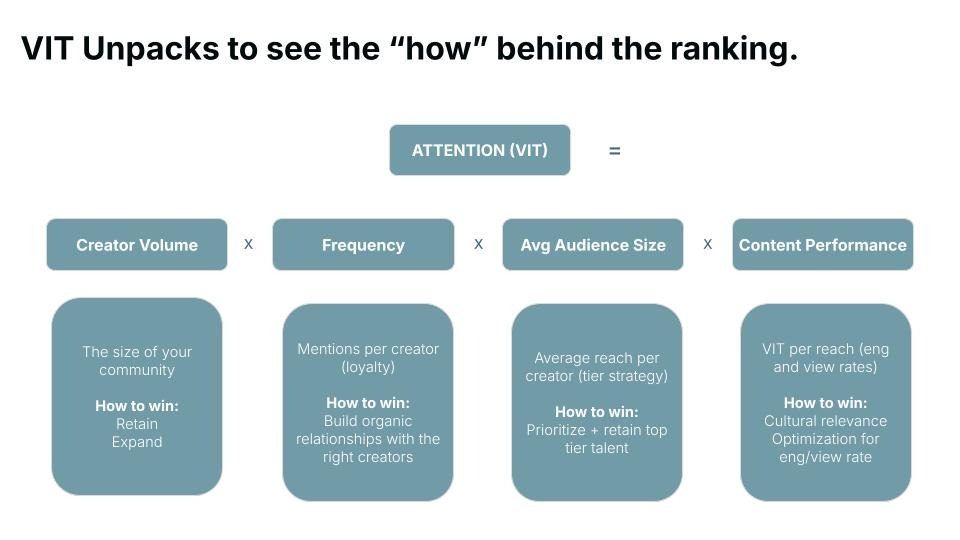
The four levers, and what each one is really telling you
The reason these four levers matter is that each one maps to a different strategic action.
Creator volume is the size of your community.
This show you how many unique creators are talking about your brand. If more creators mention your brand, you get more attention, so if your strategy this year is angled toward more awareness and broadening your community, this is the lever you're pulling.
Frequency is how often each creator mentions you.
It works hand in hand with volume. A thousand creators who mention you once is a very different program from a thousand creators who mention you three or four times a quarter. Frequency is really the loyalty read. It shows you whether creators are coming back beyond their contractual obligation because they actually like your brand and product. Repeated mentions read as genuine.
Average audience size is your tiering strategy.
Not how many creators or how often, but who. Picture your program as a pyramid. Almost every brand has a long tail of nano and micro creators at the base, and that part looks similar across the industry. Things get blurry in the middle and at the top, because that's where organizations make genuinely different choices. There's no correct pyramid. The question is whether the balance you have is the balance you intended: enough high-reach partners to carry the tentpole moments, the festival activations, the launches, and enough of creators to drive consideration and purchase intent.
Content performance is how efficiently that content earns attention, measured as a mixture of engagement and view rates (VIT per reach).
Not all posts perform equally, even from the same creator. Content performance is the clearest signal of how well brand, message, and creator are aligned. It's the lever that speaks to your creative strategy, your briefing, your platform mix, and whether you have a finger on the pulse of the cultural moments your audience is in. It’s important to dig into your paid, organic and boosting content to really understand what is driving attention across platforms and creator tiers.
"The power of VIT isn't just knowing your score. It's knowing which lever to pull." - Taylor Rodriguez, Global VP of Customer Experience at Traackr
There is no one-size-fits-all approach here. One brand might win through sheer creator volume and frequency. Another might get there with fewer, larger creators and exceptional content. Neither is wrong or better than the other. The question is which path fits your program, your budget, and your team.
That's what makes VIT a strategy tool, not just a measurement tool. When your score drops, it tells you which lever moved. When you're deciding where to invest next, it shows you which lever has the most room to grow. The path to more attention becomes a concrete, data-backed choice rather than a guess.
Running the VIT diagnostic framework yourself
Here's what this looks like in practice.
#1 Start with where you rank.
Find your brand and your competitors' performance in the last month on Traackr’s brand leaderboard. With the full Traackr subscription you can refine this to be a different period of time, as it’s best to do this practice with over the full year.
"We check the leaderboard religiously. It's how we track progress, spot gaps, and make the case for what we need to improve." Michelle Kwak, Director of Integrated Communications, LANEIGE
#2 See what's working.
Before going into where you can improve, see how you’re outperforming to know what to keep investing in. You might find your creator volume sits below your competitive set while your frequency sits above it. That combination is not a weakness. It means the creators who work with you come back more often than their volume would predict, which is genuine advocacy rather than paid repetition. If your average audience size is also running ahead of the set, you're getting that advocacy from established creators, which is one of the hardest things to achieve if you aren't buying it.
#3 Identify and understand your gap.
Say content performance is where you trail. Because that lever is expressed as a rate, more creators will not close it. You cannot volume your way out of a rate problem. The gap is pointing at platform strategy, audience targeting, and creative, which sends you to a completely different set of meetings than a volume gap would.
#4 Split the gap into paid and organic before you act on it.
Most diagnostics stop too early. A competitor running far ahead may be doing it through aggressive boosting, which is not proof that their creative is better than yours. You want to identify any dependencies that you or your competitors rely on. Addressing a boosting, platform or even creator dependency future proofs your strategy.
“With Traackr, we were able to gain insights into which influencer marketing strategies were working well for our competitors and delve into the VIT metric to understand key areas of opportunity for our brand.” — Ilse López, Avène Digital Marketing Manager
Start today by seeing where you rank on Traackr’s Brand leaderboard, and then using Traackr's IMPACT planner to see which levers will get you ahead of your competition.
You can also watch Holly Jackson, VP of Influencer Marketing Insights and Innovation at Traackr, break down the framework here.
Traackr’s technology, expertise and partnership combine to deliver significantly stronger results compared to programs run on other platforms. Schedule time with our team to learn how Traackr can help you outperform the market.

Listen to Bella Clark, Head of Influencer and Partnerships at Lipton, and content creator, Thuy Le, share why authenticity outshines extravagance when it comes to creator partnerships.
Listen nowSee which brands are leading the way in influencer marketing with our real-time performance leaderboard.
View brand leaderboard
How to Find Top Influencers in Less Time with Agentic Creator Discovery
.jpg)
Traackr Launches Abigail, the AI-Native Creator Marketing Strategist Built for the Global Enterprise

How Laboratoires Pierre Fabre Built One Global Creator Marketing Program Across 20+ Markets

Level up your creator marketing expertise
Get industry insights and updates straight to your inbox.